
Learning AI-DLC building a game, part 7: ideation
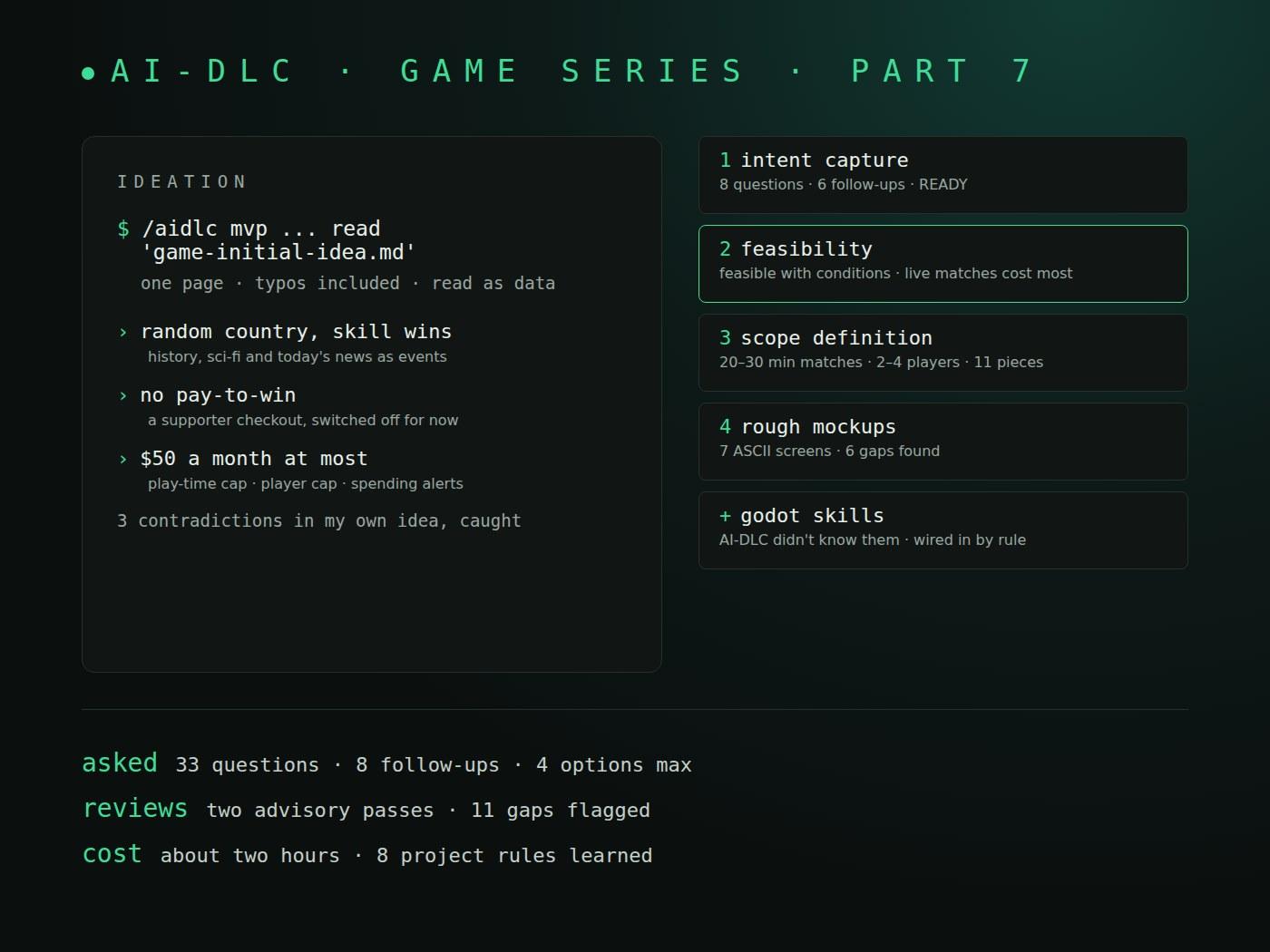
This is part 7 of a series on learning AI-DLC by building a game, World Rift Conflict, in Godot with an AWS backend. Until now the work was tooling: a sign-in proof of concept, end-to-end tests and two bugfixes. This post starts the game itself, with AI-DLC's four Ideation stages.
Parts so far:
- Part 1: setup
- Part 2: a proof of concept
- Part 3: automated E2E tests
- Part 4: what the reviews caught
- Part 5: inside a stage
- Part 6: a bugfix intent
- Part 7: ideation (this post)
TL;DR
- I started with a one-page idea file, typos included, and one command:
/aidlc mvp lets start with the game idea brainstorming read 'game-initial-idea.md'. - Four stages, 33 questions and eight follow-ups turned it into an intent, a feasibility verdict, a scope and seven rough screens.
- The questions caught three contradictions I had written into the idea myself.
- Two advisory reviews found eleven gaps, from success measures with no time window to an event card that closes before a slow reader is done.
- AI-DLC did not know about the Godot skills installed in Claude Code. I had to wire them in.
The input: an idea file
The idea file mixed history, sci-fi and real-world news. You don't choose your country, it is assigned at random, and skill should matter more than the country you got. Events from the past, the future and today change your country: an ally's help shipment from centuries ago, the Black Death, an alien that enslaves you for a while, real wars, markets and disasters. No pay-to-win. Limits on play time, because "we dont have much to spend on".
AI-DLC found the file by name and read it as untrusted data. That matters: nothing in it reached the documents directly. Every idea had to come back through a question I answered.
Intent Capture: eight questions, six follow-ups
The questions were built from my own file. One asked which of six ideas were the heart of the game, and I picked all six. Others asked what wins when fun, learning and promoting my website pull apart (fun), and the most I want to spend a month ($50).
Then the follow-ups started. Four of them came from a tool limit, not from my answers. The Claude Code picker holds four options, so a five-option question was split over two pickers, and the picker wants an answer in each. I picked in both parts every time, and AI-DLC had to ask which one counted. From the second stage on, every question had four options at most. That is now a project rule.
One follow-up was a real contradiction. I said the first version should leave out only extra historical periods, so payments and multiplayer were in. My own idea file says pricing waits until running costs are known. AI-DLC showed both answers side by side. I kept payments in, and the conflict went into the record as an open assumption.
The product-lead review called the intent READY, with two major findings. The first version had almost no boundary. "20 players daily" had no time window and no definition of a player, so it could not be checked.
Feasibility: what one builder can carry
AI-DLC filled the questions it could answer from earlier work, citing the sources: the existing sign-in backend, the stack, the AWS services, the budget. It asked only what was open. My answers made it harder: no deadline, more than ten hours a week, live matches, players worldwide aged 13 and over, payments through a provider, paid data feeds allowed, and downloads for Windows, macOS and Linux.
That added up to more than $50 might hold, so it asked one more question: what gives way first? Paid data feeds, falling back to free public data.
The verdict was feasible with conditions. Today nothing of mine runs on a server, so live matches are the biggest new cost and the biggest new build. The risk log added one I hadn't thought of: with 20 daily players, people may wait a long time for opponents.
Scope: closing what was left open
Scope Definition spent its nine questions on the findings and risks the earlier stages had left open:
| Open point | Settled as |
|---|---|
| Which period | the present day, so real-world data fits directly |
| What a match is | 20 to 30 minutes, fixed rounds, highest score wins |
| Waiting for opponents | 2 to 4 players; computer-run countries fill empty seats |
| Payments vs pricing | a supporter checkout, built but switched off until costs are known |
| Viral costs | a daily play-time cap, a cap on players at once, spending alerts |
| Success windows | 20 players on 5 of the first 7 days; replays over the first 20 matches |
The backlog has eleven pieces in value-first order. A fun match against computer-run countries comes first, since it needs no server. Live online play comes eighth, after accounts and a cost estimate. Nine are Must, more than the usual 60%, and the document says why: I put every core idea in, so each one has to stay small.
Rough Mockups: seven ASCII screens
The last Ideation stage asked what the screens show, not how they look. I chose an explainer page before sign-in, and a dashboard during the match: you set priorities, then watch the round play out against a fixed timer. Big events show as a card everyone sees, small ones in a news feed. For the style I typed "sci fy, futuristtic, techy", and that is kept for later.
The match screen came out like this:
+----------------------------------------------------------------+
| Round 4 of 12   Time left 0:47   Score 860   [Country]         |
+----------------------------------------------------------------+
| PRIORITIES (set, then watch)  | NEWS FEED                      |
|   Economy      [#####-----]   | R3 Drought hits farms (*)      |
|   Technology   [###-------]   | R3 Rival signs a treaty        |
|   Military     [##--------]   | R2 Markets fall 3% (*)         |
|   Diplomacy    [####------]   |                                |
|   [ Lock in priorities ]      | (*) real data, with source     |
| ------------------------------+------------------------------- |
| STATS                         | MAP (small)                    |
|   Wealth 120  Tech 45         |   [you]  [P2]                  |
|   Power  30   Relations +2    |   [cpu]  [P3]                  |
+----------------------------------------------------------------+
| Players: You 860 | P2 910 | P3 700 | CPU 640                   |
+----------------------------------------------------------------+
The review found six gaps. Two were major. Desktop downloads are in scope, but no screen tells a player where to get one. The event card also closes on its own after eight seconds, which works against the keyboard and screen-reader goal I had just chosen. I approved with both open. They are cheap to fix in Refined Mockups.
AI-DLC doesn't know your other skills
Halfway through the mockups I asked whether AI-DLC knew about the Godot and design skills installed in Claude Code. It doesn't. Its agents read their own method notes and the project's rules, nothing else. So I put the rule in two places: a section in the root CLAUDE.md, which every session and sub-agent loads, and a project rule saved through AI-DLC's "anything to add?" question. From the Inception stages on, design and code stages check for a matching Godot skill first.
What it cost
About two hours, four stages, four approvals and eight project rules learned along the way. What I got is a scope I can argue with: what is in, what is out, what a match is, and what success means, with dates. The idea file had none of that.
What is next
Inception: Reverse Engineering of the existing code, then requirements, stories and the units of work the game is built from.