
Kiro features timeline: what shipped, where, and how to use it
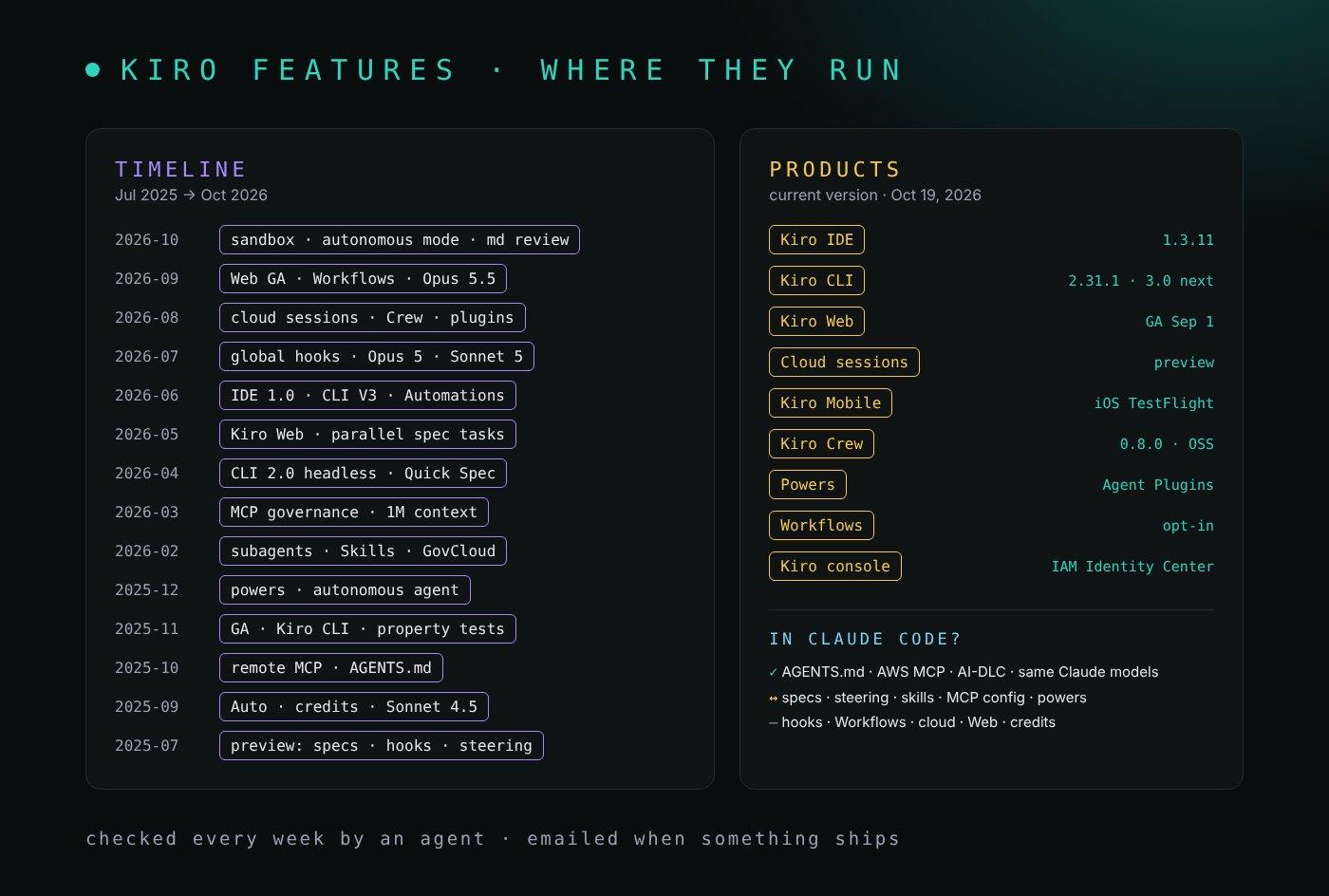
Kiro ships something almost every week: an IDE release on Monday, a CLI release on Tuesday, a new model on Thursday, a Web feature on a date with no version number at all. I use Kiro next to Claude Code on every side project, and more than once I have found a Kiro feature days after it shipped, after doing by hand exactly what it automates. This post is the fix, built the same way as my Claude features timeline: a timeline of every notable feature on one side and the Kiro products that use it on the other, the current version of each product, whether the feature also works when you run the Claude Code extension inside Kiro, and for the features that matter most, the best use case and an example you can run today.
Last checked: October 19, 2026. A scheduled agent re-reads Kiro's changelog every week, updates this post and emails me the changes. How that works is at the end.
TL;DR
- Kiro is now one agent harness on many surfaces: the IDE, the CLI, Kiro Web (which absorbed the autonomous agent), cloud sessions, an iOS app, the open-source Kiro Crew, and any editor that speaks the Agent Client Protocol. They share the same
.kiro/configuration. - Current versions: Kiro IDE 1.3.11, Kiro CLI 2.31.1 (3.0, with the V3 harness as the default, is due at the end of October), Kiro Web GA since September 1, Kiro Crew 0.8.0.
- The biggest shifts of the last year: from one IDE to every surface (CLI, Web, Mobile, cloud sessions), from single prompts to orchestration (subagents, parallel spec tasks, Workflows), from "approve every command" to permissions, a sandbox and autonomous mode, and from Claude-only to many models (Claude, GPT‑5.6, open-weight).
- In the Claude Code extension, the shared layer is plain files:
AGENTS.md, spec and steering Markdown,SKILL.mdfolders and MCP servers, including AWS's own Agent Toolkit for AWS. Hooks, Workflows, cloud sessions and credits stay Kiro-only. - If you adopt only five things: specs, steering (or
AGENTS.md), hooks, powers, and Workflows.
The products and their current versions
| Product | What it is | Current version | Release notes |
|---|---|---|---|
| Kiro IDE (macOS, Windows, Linux) | The desktop editor, a fork of Code OSS, with specs, steering, hooks and chat | 1.3.11 (Oct 15, 2026); 1.0 shipped Jun 25, 2026 | IDE changelog |
Kiro CLI (kiro-cli, macOS, Linux, Windows 11) | The terminal agent, successor of the Amazon Q Developer CLI | 2.31.1 (Oct 14, 2026); V3 harness opt-in, default in 3.0 | CLI changelog · CLI 3.0 |
| Kiro Web (app.kiro.dev) | Agent in the browser: collaborative and autonomous modes, GitHub and GitLab | GA since Sep 1, 2026 | Web changelog |
| Cloud sessions | The same harness in a managed sandbox, started from the IDE, CLI, Web or phone | Preview (IDE 1.0.293+, CLI 2.17+) | Docs |
| Kiro Mobile (iOS) | Start and steer cloud sessions from your phone | Early access on TestFlight, iOS 26+, paid plans | Docs |
| Kiro Crew | Open-source orchestrator that drives kiro-cli over ACP, with Slack, Discord and Teams bots | 0.8.0 (Sep 27, 2026) | Crew changelog · 0.8 |
| Powers | Installable bundles of skills, MCP servers, steering and hooks | Agent Plugins format since IDE 1.0.288; kiro-cli powers install since 2.25 | Docs · kirodotdev/powers |
| Workflows | Recipes of agent steps, each in its own session, with loops and stop conditions | Opt-in since Sep 30, 2026 (IDE 1.2, CLI 2.26, Web) | Docs |
| Kiro console (enterprise) | Users, billing and governance; the renamed Amazon Q Developer console | IAM Identity Center, Okta, Entra ID; us-east-1, eu-central-1, GovCloud | Docs |
| Plans | Credits shared by every surface | Free (50 credits), Pro $20 (1,000), Pro+ $40 (2,000), Pro Max $100 (5,000), Power $200 (10,000); overage $0.04 per credit | Pricing |
One harness, every surface, and where Claude Code fits
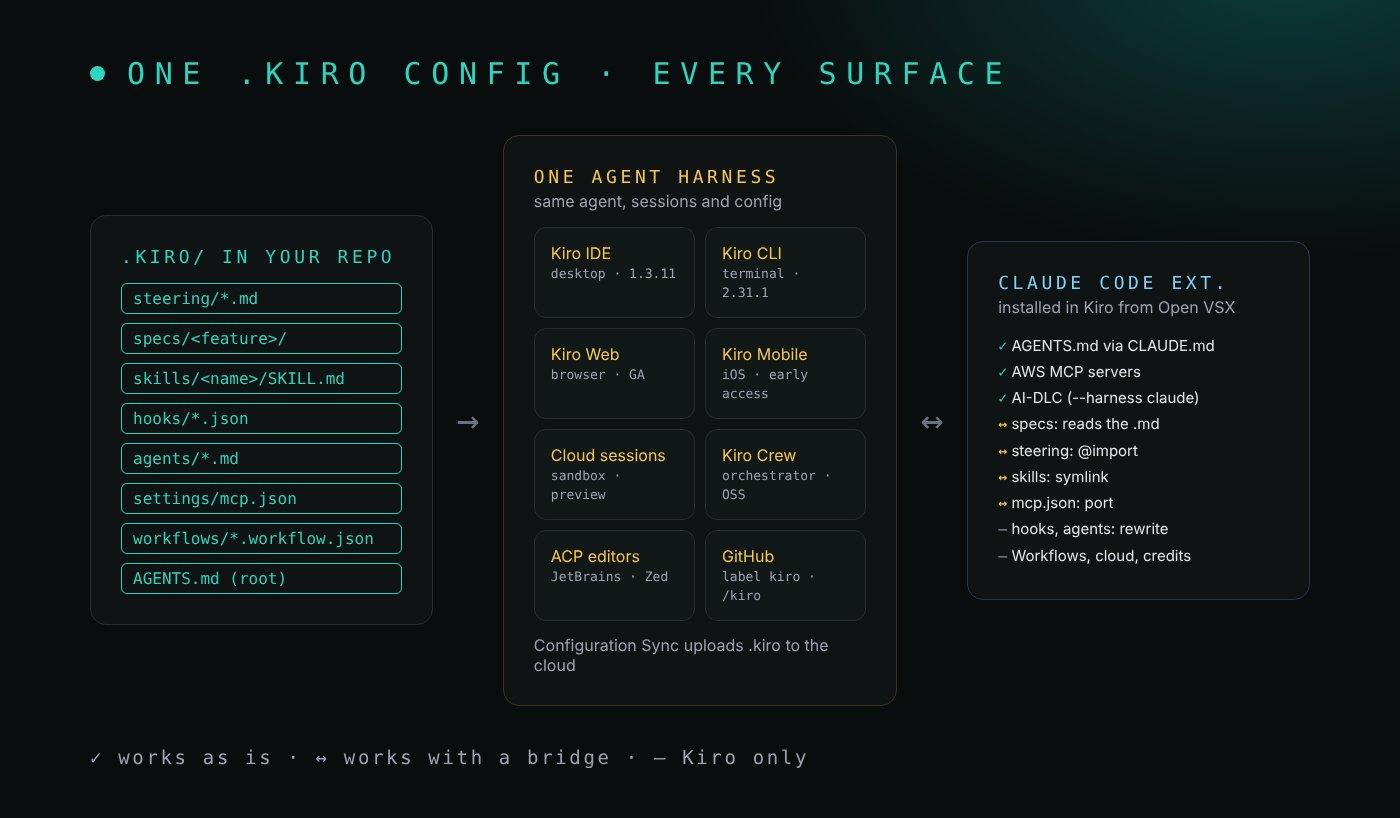
The thing that makes Kiro easy to miss is also what makes it easy to adopt: since IDE 1.0 and the CLI's V3 harness, every surface runs the same agent against the same .kiro/ folder. A steering file you write for the IDE is read by the CLI, by a cloud session your phone started, and by a Workflow step.
The Claude Code extension installs in Kiro from the Open VSX registry; Anthropic's own VS Code docs name Kiro as a supported fork. It runs on your Anthropic plan (or Bedrock), not on Kiro credits, and it does not see Kiro's agent. What it shares with Kiro is the files. In the timeline below, the Claude Code column says:
- ✓ works as is in the extension,
- ↔ works with a small bridge (an
@import, a symlink, a ported config), - — Kiro only. Where Claude Code has its own equivalent, I name it.
The timeline: feature ↔ products
Newest first. Products are where you can use the feature today, not only where it launched. The ★ rows have a use case and an example further down.
| Date | Feature | Kiro products | Claude Code |
|---|---|---|---|
| 2026‑10‑15 | Markdown review panel: comment on passages of a spec or .md, send them in one batch | IDE 1.3.11 | — |
| 2026‑10‑15 | Kimi K3 (experimental), 1M context | IDE, CLI, Web, Crew | — |
| 2026‑10‑13 | ★ Local command sandbox and local autonomous mode | IDE 1.3, CLI 2.31 (V3) | — (own /sandbox, auto mode) |
| 2026‑10‑12 | CLI 3.0 announced: V3 harness becomes the default at the end of October | CLI | — |
| 2026‑10‑02 | Claude Sonnet 5.5 (experimental), 1M context | IDE, CLI, Web, Crew | ✓ native |
| 2026‑09‑30 | ★ Workflows: recipes of agent steps with loops and stop conditions | IDE 1.2, CLI 2.26, Web, Crew | — (own workflows) |
| 2026‑09‑30 | Sign-in method controls and in-region telemetry for enterprises | IDE, CLI, console | — |
| 2026‑09‑28 | Claude Opus 5.5 (experimental), also in GovCloud | IDE, CLI, Web, Crew | ✓ native |
| 2026‑09‑28 | kiro-cli powers install | CLI 2.25 | — |
| 2026‑09‑27 | Kiro Crew 0.8: crewmate teams (preview), agent templates, quieter watches | Crew | — |
| 2026‑09‑14 | Agent Artifacts and native ARM64 builds | IDE 1.1 | — |
| 2026‑09‑01 | ★ Kiro Web GA; synced cloud config applies to local sessions | Web, IDE, CLI | — |
| 2026‑08‑27 | GPT‑5.6 Sol, Terra and Luna | IDE, CLI, Web | — |
| 2026‑08‑13 | Nested AGENTS.md scopes instructions to a folder | IDE 1.0.309, CLI 2.18 (V3) | ↔ @import |
| 2026‑08‑11 | ★ Cloud sessions (preview) and Configuration Sync | IDE, CLI, Web, Mobile | — |
| 2026‑08‑07 | ★ Powers in the Agent Plugins format, install from a folder or GitHub URL | IDE 1.0.288, CLI V3, Web | ↔ reuse skills, MCP |
| 2026‑08‑04 | ★ Kiro Crew 0.1: open-source orchestrator over ACP | Crew | — |
| 2026‑07‑24 | Claude Opus 5 (experimental) | IDE, CLI, Web | ✓ native |
| 2026‑07‑20 | Global hooks in ~/.kiro/hooks/ and session search | IDE 1.0.182, CLI V3 | — rewrite |
| 2026‑07‑01 | Claude Sonnet 5 | IDE, CLI, Web | ✓ native |
| 2026‑06‑25 | ★ Kiro IDE 1.0: parallel agent sessions, permissions.yaml, custom agents as Markdown, hooks v1 | IDE (CLI V3 has the same) | ↔ agents, — hooks |
| 2026‑06‑25 | FedRAMP High and DoD IL‑4/5 in GovCloud | IDE, CLI | — |
| 2026‑06‑19 | Automations: scheduled cloud runs that open pull requests | Web | — (Routines) |
| 2026‑06‑17 | ★ CLI V3 early access: specs in the terminal, permissions, standalone hooks | CLI 2.8+ (--v3) | ↔ spec files |
| 2026‑06‑12 | /goal <objective>: plan, implement and verify in a loop until the goal is met | CLI 2.7 | — (own /goal) |
| 2026‑06‑11 | Pro Max plan, $100 for 5,000 credits | All | — |
| 2026‑06‑05 | aws configure agent-toolkit: the AWS CLI sets up the Agent Toolkit for the agents it finds | IDE, CLI | ✓ |
| 2026‑05‑29 | Claude Opus 4.8 | IDE, CLI, Web | ✓ native |
| 2026‑05‑07 | ★ Kiro Web preview: browser agent, multi-repo PRs, GitHub triggers | Web | — |
| 2026‑05‑06 | ★ Parallel spec tasks, Quick Plan, Analyze Requirements | IDE 0.12, CLI V3, Web | ↔ reads tasks.md |
| 2026‑05‑06 | ★ Agent Toolkit for AWS and AWS MCP Server GA: AWS's MCP server, skills and plugins for coding agents | IDE, CLI, Web (MCP, skills) | ✓ aws-core plugin |
| 2026‑04‑13 | ★ Kiro CLI 2.0: Windows, headless mode for CI, new terminal UI | CLI | — (claude -p) |
| 2026‑04‑02 | Quick Spec (/quick-spec); MiniMax M2.5 and GLM‑5 | IDE 0.11.130 | — |
| 2026‑03‑24 | 1M context for Claude Opus 4.6 and Sonnet 4.6 | IDE, CLI | ✓ native |
| 2026‑03‑11 | MCP registry and model governance; PDF, DOCX, XLSX attachments | IDE 0.11, CLI | — |
| 2026‑02‑18 | ★ Design-first and bugfix specs, hunk review, Pre/Post Task hooks, MCP prompts | IDE 0.10 | ↔ spec files |
| 2026‑02‑16 | Kiro in AWS GovCloud (US); open-weight models (DeepSeek, MiniMax, Qwen) | IDE, CLI | — |
| 2026‑02‑12 | Okta and Microsoft Entra ID sign-in with SCIM | IDE, CLI, Web | — |
| 2026‑02‑05 | ★ Custom subagents and ★ Agent Skills; Pre/Post Tool Use hooks; Claude Opus 4.6 | IDE 0.9, CLI | ↔ skills (symlink) |
| 2026‑02‑04 | kiro-cli acp: use Kiro from JetBrains, Zed and other ACP editors | CLI 1.25 | — |
| 2026‑01‑16 | Skills in the CLI, /compact, code intelligence for 18 languages | CLI 1.24 | ↔ skills |
| 2025‑12‑18 | Subagents, web search and fetch, Prompt Submit and Agent Stop hooks, .kiroignore | IDE 0.8, CLI 1.23 | — |
| 2025‑12‑03 | ★ Powers: MCP, steering and hooks that load on keywords | IDE 0.7, CLI V3, Web | ↔ reuse parts |
| 2025‑12‑02 | Kiro autonomous agent (preview, re:Invent); now autonomous mode in Kiro Web | Web | — |
| 2025‑11‑29 | AI-DLC workflows open-sourced by AWS Labs | IDE, CLI | ✓ --harness claude |
| 2025‑11‑24 | Claude Opus 4.5 (experimental) | IDE, CLI | ✓ native |
| 2025‑11‑17 | ★ GA with property-based testing and checkpoints; ★ Kiro CLI launches | IDE 0.6, CLI | — |
| 2025‑10‑31 | ★ Remote MCP, global steering, AGENTS.md support | IDE 0.5, CLI | ✓ AGENTS.md, ↔ MCP |
| 2025‑09‑29 | Claude Sonnet 4.5; optional (MVP) spec tasks | IDE 0.3 | ✓ native |
| 2025‑09‑17 | Auto model router and credit-based pricing | All | — |
| 2025‑07‑14 | ★ Preview: specs (EARS), steering, agent hooks, MCP, Autopilot and Supervised | IDE 0.1 | ↔ specs, steering |
Best use cases, with an example for each
Grouped by what they help you do, not by date. Each one says when it pays off and gives an example you can paste, plus how to get the same thing in the Claude Code extension.
Plan before code: specs
Specs (Jul 2025; design-first and bugfix specs Feb 2026; parallel tasks May 2026) · IDE, CLI V3, Web. Three Markdown files per feature in .kiro/specs/<feature>/: requirements.md in EARS notation, design.md, and tasks.md (or bugfix.md for a bug). Analyze Requirements checks the requirements for contradictions; Run all Tasks runs independent tasks in parallel waves; Kiro generates property-based tests from the requirements.
Best for: any feature that touches more than three files, or any bug you want fixed without breaking what works.
## Requirement 1: Rate-limit the contact form

**User story:** As the site owner, I want repeated submissions blocked, so that spam does not reach my inbox.

#### Acceptance criteria

1. WHEN a visitor submits the form more than 3 times in 10 minutes from the same IP THE SYSTEM SHALL reject the request with HTTP 429.
2. WHEN a submission is accepted THE SYSTEM SHALL send one email through Amazon SES and respond with HTTP 200.
3. IF the honeypot field is filled THEN THE SYSTEM SHALL return HTTP 200 without sending an email.
In the IDE, start a spec from the chat panel; in the CLI V3, run /spec new. Reference a spec in chat with #spec.
In Claude Code ↔: the files are plain Markdown, so the extension can read and implement them (@.kiro/specs/contact-rate-limit/tasks.md), but you lose Kiro's task status, parallel waves and generated property tests. This is the format my own spec-first workflow uses, so both agents work from the same spec.
Teach the agent once: steering, AGENTS.md and skills
Steering (Jul 2025; auto inclusion Feb 2026) · IDE, CLI, Web. Markdown files in .kiro/steering/ (project) or ~/.kiro/steering/ (global), with four inclusion modes in the front matter.
Best for: conventions the agent must follow on every request (always), only for some files (fileMatch), on demand (manual, becomes a slash command), or when the request matches a description (auto).
---
inclusion: fileMatch
fileMatchPattern: ["amplify/**/*.ts"]
---

# Amplify Gen 2 backend rules

- Define every function with `defineFunction` in `amplify/functions/<name>/resource.ts`.
- Read secrets with `secret('NAME')`, never from `process.env` in source.
- Grant SES access through `backend.<fn>.resources.lambda.addToRolePolicy`, scoped to one identity.
AGENTS.md (Oct 2025; nested since Aug 2026) · IDE, CLI. A root AGENTS.md is always-included steering, and a nested one applies to its folder.
Best for: the rules you want every agent to follow, Kiro and Claude Code alike.
In Claude Code ✓: make AGENTS.md the source of truth and import it, plus any steering you want, from CLAUDE.md. Claude Code reads the text but ignores Kiro's inclusion: front matter, so import only the steering that should always apply.
# CLAUDE.md
@AGENTS.md
@.kiro/steering/tech.md
@.kiro/steering/structure.md
Agent Skills (IDE 0.9 and CLI 1.24, early 2026) · IDE, CLI, Web. The same open SKILL.md format Claude uses, in .kiro/skills/<name>/ or ~/.kiro/skills/<name>/; only the name and description load until a request matches.
Best for: procedures, not rules: "open a release PR", "add a new article in both languages".
In Claude Code ↔: same format, different folder. Keep one copy and link the other:
mkdir -p .claude
ln -s ../.kiro/skills .claude/skills   # Claude Code now loads the same skills
Automate the boring checks: agent hooks
Agent hooks (Jul 2025; v1 JSON format with IDE 1.0 and CLI V3; global hooks Jul 2026) · IDE, CLI V3. JSON files in .kiro/hooks/ or ~/.kiro/hooks/. A hook runs a shell command or asks the agent something on an event: SessionStart, UserPromptSubmit, PreToolUse, PostToolUse, PreTaskExec, PostTaskExec, PostFileCreate, PostFileSave, PostFileDelete, Stop. Exit code 2 blocks the action on PreToolUse, PreTaskExec and UserPromptSubmit.
Best for: lint and test on save, blocking a dangerous command, adding fresh context to every prompt.
{
  "version": "v1",
  "hooks": [
    {
      "name": "lint-on-save",
      "trigger": "PostFileSave",
      "matcher": "\\.(ts|tsx|mdx)$",
      "action": { "type": "command", "command": "npm run lint" },
      "timeout": 30,
      "enabled": true
    }
  ]
}
In Claude Code —: the events and the exit-code-2 rule are almost the same, but Claude Code reads hooks from settings.json, so port them by hand. Hooks written for the 0.x IDE (.kiro.hook files) no longer run; IDE 1.0 migrates them.
Connect tools: MCP and powers
MCP (Jul 2025; remote servers Oct 2025; governance Mar 2026) · IDE, CLI, Web. .kiro/settings/mcp.json (project) merged over ~/.kiro/settings/mcp.json (user). Local servers over stdio, remote ones over Streamable HTTP with OAuth.
Best for: giving the agent your docs, your cloud and your tickets. The example is the AWS MCP Server from the Agent Toolkit for AWS, covered in the AWS section below.
{
  "mcpServers": {
    "aws": {
      "command": "uvx",
      "args": [
        "mcp-proxy-for-aws-cli@latest",
        "https://aws-mcp.us-east-1.api.aws/mcp",
        "--metadata",
        "AWS_REGION=us-west-2"
      ]
    }
  }
}
In Claude Code ↔: the mcpServers shape is the same, so a stdio entry ports to .mcp.json as is. Drop Kiro-only keys such as autoApprove and disabledTools, and for a remote server use "type": "http" with url instead of Kiro's url and headers.
Powers (Dec 2025; Agent Plugins format Aug 2026) · IDE, CLI V3, Web. A power bundles skills, MCP servers, steering and hooks, and only loads when your request matches its keywords, so twenty installed powers do not fill the context window. Launch partners include Datadog, Figma, Stripe, Supabase, Netlify, Postman and Neon, plus a shelf of AWS powers. Install one from the Powers panel, from a GitHub URL or with kiro-cli powers install. A power's manifest is a plugin.json:
{
  "$schema": "https://agent-plugins.org/schemas/1.0.0/plugin.schema.json",
  "name": "contact-form",
  "displayName": "Contact form on Amplify",
  "version": "1.0.0",
  "description": "Amplify Gen 2 function, SES and rate limiting for contact forms.",
  "keywords": ["contact form", "ses", "rate limit", "amplify"],
  "license": "MIT"
}
Next to it go skills/, an mcp.json and optional steering.
Best for: packaging "how we do X here" with the tools it needs, for a team or for your future self.
In Claude Code ↔: the manifest is not a Claude Code plugin, but the skills/ and mcp.json inside a power work there with the bridges above.
Delegate and orchestrate: subagents, custom agents and Workflows
Custom agents and subagents (Dec 2025 → Jun 2026) · IDE, CLI. Markdown files in .kiro/agents/ with a model, tools, MCP servers and permissions in the front matter. In the CLI, kiro-cli agent create, /agent swap, and /upgrade-agent to convert an older config to the current schema (/upgrade-agent diagnostics only reports).
---
description: Reviews Amplify backend changes for IAM scope and secrets
model: claude-sonnet-5.5
tools: [read, shell]
permissions: { rules: [ { capability: shell, effect: allow, match: ["npx ampx *", "npm test*"] } ] }
---
You review only files under amplify/. Flag any IAM policy with a wildcard resource
and any secret read from process.env. Never edit files.
An agent can also be a JSON file in the same folders: .kiro/agents/ in the project wins over ~/.kiro/agents/, and the file name, without .json or .md, becomes the agent's name. This is the example from Kiro's docs, and it shows fields the Markdown version above leaves out, as the configuration reference defines them: excludedTools drops a tool even when tools allows it, includeMcpJson adds the MCP servers from your mcp.json files, includePowers adds the powers installed in the IDE, resources loads files at startup (file://, globs allowed) and skills on demand (skill://, only the name and description at startup), and welcomeMessage is shown when you switch to the agent. Model IDs use dots (claude-sonnet-4.6), unlike the hyphens of the Anthropic API.
{
  "name": "my-agent",
  "description": "A custom agent for my workflow",
  "tools": ["read", "write", "shell"],
  "excludedTools": ["knowledge"],
  "includeMcpJson": true,
  "includePowers": false,
  "resources": [
    "file://./ARCHITECTURE.md",
    "skill://backend-patterns"
  ],
  "permissions": {
    "rules": [
      { "capability": "shell", "match": ["npm *", "git *"], "effect": "allow" }
    ]
  },
  "prompt": "You are a helpful coding assistant",
  "model": "claude-sonnet-4.6",
  "welcomeMessage": "Ready to help. What are you working on?"
}
In Claude Code ↔: the idea maps to .claude/agents/*.md, but tool names and permissions differ, so copy the prompt, not the front matter.
Workflows (Sep 30, 2026) · IDE 1.2, CLI 2.26 (V3), Web, Crew. A recipe in .kiro/workflows/<name>.workflow.json is a graph of step, sequence, parallel, repeat and watch nodes; each step runs as its own agent session in the background. Three recipes ship built in: investigate, feature-pipeline and publish-pr. Turn it on in IDE settings (kiroAgent.workflows.enabled), under /settings → Features in the CLI, or in Web settings.
Best for: a repeatable multi-step job you would otherwise prompt step by step, such as spec → implement → verify → review → PR.
/workflow run investigate --brief "Trace timeout configuration" --report_path /path/to/report.md
Each recipe input is a --<name> flag, as in this example from Kiro's docs; run /workflow run alone to pick a recipe, or name feature-pipeline in chat and describe the task. I wrote up two real recipes, and the two bugs the validator caught, in Automating my ship pipeline with Kiro Workflows recipes.
In Claude Code —: Claude Code has its own workflows and subagents; the recipes do not port.
Let it run without you: Kiro Web, cloud sessions, Automations and Mobile
Kiro Web (preview May 2026, GA Sep 1, 2026) and cloud sessions (preview Aug 2026) · Web, IDE, CLI, Mobile. The autonomous agent from re:Invent 2025 is now Kiro Web's autonomous mode: it works in a cloud sandbox, across several repositories, and opens pull requests. Start a session from Web, from the IDE or CLI as a cloud session, from the iOS app, or from GitHub, once the Kiro Agent GitHub app is installed: add the kiro label to an issue, or mention /kiro in a comment to assign it. On the pull request it opens, /kiro fix addresses the comments in one review thread and /kiro all every reviewer's comments. Automations (Jun 2026) run a session on a schedule.
Best for: well-specified issues you can hand off overnight, and fixing review comments without opening your laptop.
Implement the spec in .kiro/specs/contact-rate-limit and open a pull request.

/kiro
Put the instructions in the issue body; the agent also reads later comments, but only from the person who created the task. It branches from the repository's default branch, so if you work from staging as I do, make it the default or say which base to use in the issue. Upload your .kiro config with Configuration Sync first. Scripts outside .kiro/ and credentials do not sync, the gotcha I hit in the Workflows post.
In Claude Code —: the equivalents are Claude Code on the web and Routines, covered in my Claude features timeline.
Trust the agent more: permissions, sandbox and autonomous mode
Permissions (IDE 1.0 and CLI V3, Jun 2026), local command sandbox and local autonomous mode (Oct 13, 2026) · IDE 1.3, CLI 2.31 (V3). Rules in ~/.kiro/settings/permissions.yaml allow or deny capabilities (filesystem, shell, built-in tools) by pattern. /sandbox puts the agent's shell commands and local MCP servers inside an OS-level sandbox with blocked, limited or open network access. /autonomous on switches to the default agent, turns the sandbox on, and stops asking before each command.
Best for: long tasks such as "make every test pass" without clicking approve fifty times, and without giving the agent your whole machine.
/sandbox
/autonomous on
/goal npm test and npm run lint both pass
/goal takes the objective as free text and derives the acceptance criteria from it, so say what "done" means: "all tests pass" gives the agent something to verify, "clean up the code" does not. The loop runs up to 5 iterations by default; --max <N> raises that to at most 50, and /goal clear cancels it (docs).
In Claude Code —: same idea, different switches: auto mode, /sandbox and /goal.
Work from the terminal and CI: Kiro CLI
Kiro CLI (Nov 2025; 2.0 in Apr 2026; V3 harness from Jun 2026) · CLI. The former Amazon Q Developer CLI, now with specs, subagents, skills, hooks, powers, Workflows, headless mode for CI (API key), /rewind, /model with effort, and kiro-cli acp so JetBrains or Zed can use Kiro as their agent.
Best for: running the same agent and config in CI or over SSH, and trying the V3 harness before 3.0 makes it the default.
curl -fsSL https://cli.kiro.dev/install | bash
kiro-cli --v3        # opt in to the V3 harness now
kiro-cli --list-models
Many models: Auto and experimental models
Auto (Sep 2025) routes each request at a 1.0× credit rate and never to experimental models. Claude models arrive within days of Anthropic's launch (Opus 5.5 on Sep 28, Sonnet 5.5 on Oct 2, 2026), with a credit multiplier (for example 1.3× for Sonnet 5.5, 2.0× for Opus 5.5). Kiro also offers GPT‑5.6 and open-weight models (DeepSeek, MiniMax, Qwen, GLM, Kimi), some on the Free plan. Admins can allow or block models in the Kiro console. Best for: Auto as the default; a pinned Claude model for spec writing and hard refactors; a cheap open-weight model for bulk edits.
How Kiro integrates with the AWS ecosystem
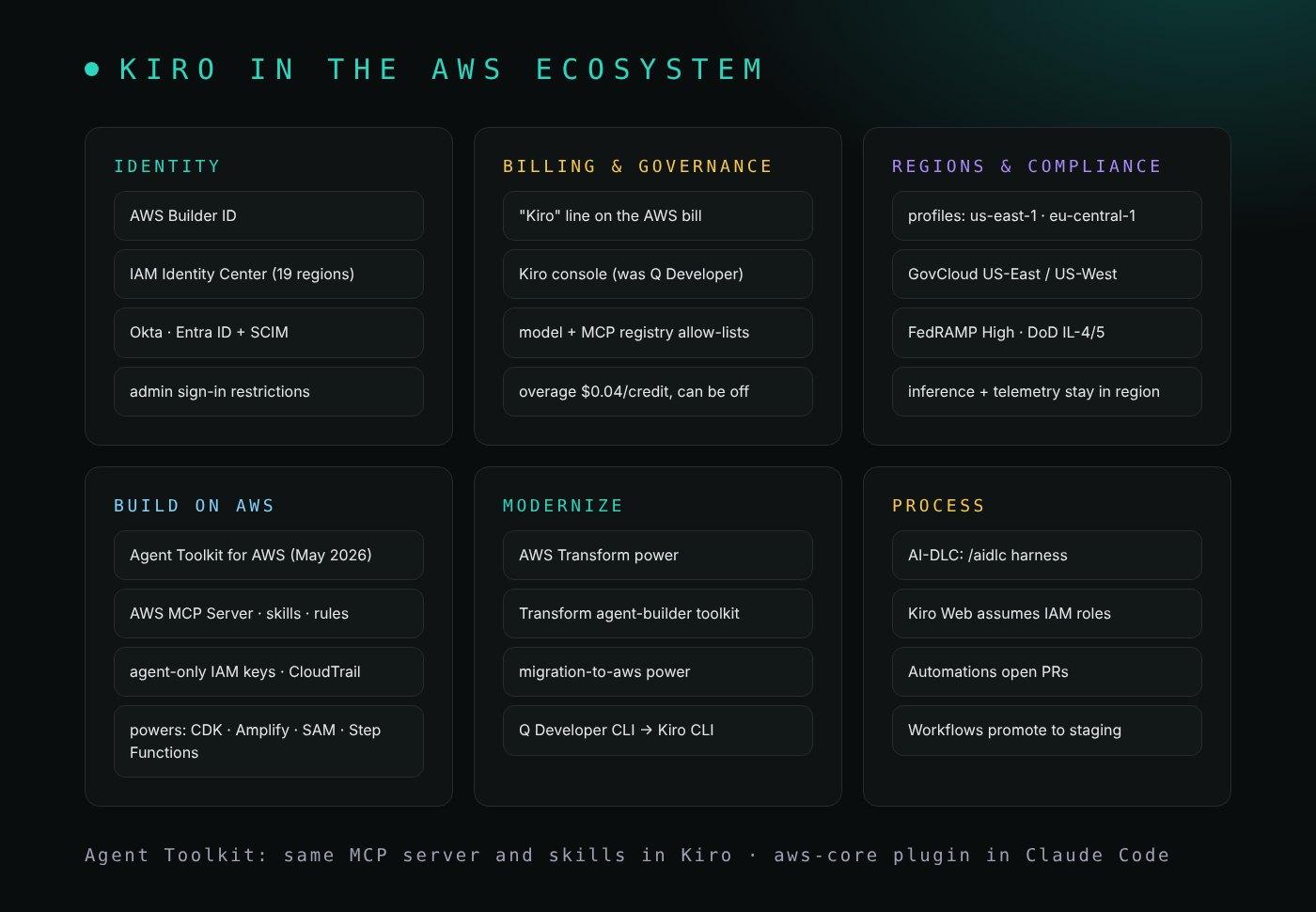
Kiro is an AWS product, and it shows less in the editor than in everything around it:
- Identity. Individuals sign in with GitHub, Google or an AWS Builder ID. Organizations use AWS IAM Identity Center, or Okta and Microsoft Entra ID with SCIM since February 2026, and admins can restrict which methods are allowed.
- Billing and governance. An organization's Kiro usage appears on its AWS bill under "Kiro" and rolls up through consolidated billing. The Kiro console (the renamed Amazon Q Developer console) manages users, overage, and allow-lists for models and MCP servers. If you still use Amazon Q Developer, the Q Developer CLI became Kiro CLI, and the Q Developer IDE plugins reach end of support on April 30, 2027 (migration guide).
- Regions and compliance. A Kiro profile lives in us-east-1, eu-central-1, or AWS GovCloud (US), and requests and telemetry stay in that region. GovCloud has been available since February 2026, with FedRAMP High and DoD IL-4/5 since June 2026. Inference there runs on Amazon Bedrock.
- Building on AWS. The Agent Toolkit for AWS gives the agent AWS's APIs, docs and skills; it has its own section below. The older awslabs/mcp servers still work, but the toolkit replaces them. The AWS powers package CDK and CloudFormation, Amplify, SAM, Step Functions, AgentCore, observability and Graviton migration, and Amplify documents building with Kiro. Kiro Web sandboxes can assume IAM roles.
- Modernizing. The AWS Transform power runs custom code transformations from Kiro, and the agent-builder toolkit power lets you build your own.
- Process. AWS's own method, AI-DLC, installs as
/aidlcin Kiro and in Claude Code. I compare it with Anthropic's playbook and my workflow in Anthropic's AI SDLC vs AWS AI-DLC vs Cursor pstack vs my workflow.
curl -fsSL https://github.com/awslabs/aidlc-workflows/releases/latest/download/install.sh | sh
aidlc config --harness kiro      # or kiro-ide, or claude
The Agent Toolkit for AWS: one AWS layer for both agents
The Agent Toolkit for AWS (announced May 6, 2026) is AWS's official kit for coding agents, and it replaces the awslabs MCP servers, skills and plugins I would otherwise point you to. It works with Kiro, Claude Code, Codex and Cursor, costs nothing beyond the AWS resources your agent uses, and has four parts:
- The AWS MCP Server, a managed remote server in us-east-1 and eu-central-1: the APIs of more than 300 AWS services behind one authenticated endpoint, sandboxed Python script execution, and live documentation search that needs no credentials.
- Agent controls you do not get from the awslabs servers. Every request lands in CloudWatch metrics and CloudTrail, and IAM condition keys tell agent actions apart from human ones, so you can allow an agent read-only access through the MCP server even when your own role can write.
- Skills:
SKILL.mdpackages for CDK, CloudFormation, serverless, IAM, containers, billing and more, evaluated end to end and loaded on demand. - Plugins and rules: plugins for Claude Code, Codex and Cursor (
aws-coreto start, plusaws-agents,aws-data-analytics,aws-agents-for-devsecopsandaws-startup-advisor), and rules files that tell the agent to prefer the MCP server, load a skill before acting and check the docs instead of guessing.
In Kiro, setup is two independent parts: the AWS MCP Server entry from the MCP section above in .kiro/settings/mcp.json, and the skills.
npx skills add aws/agent-toolkit-for-aws/skills   # Kiro: skills into .kiro/skills/ or ~/.kiro/skills/
aws configure agent-toolkit                        # or: let the AWS CLI set up the agents it finds
In Claude Code ✓, one plugin from Anthropic's official marketplace bundles the same MCP server and skills:
/plugin install aws-core@claude-plugins-official
Both setups draw on the same skills repository, so Kiro and the Claude Code extension get the same AWS guidance. The toolkit's rules/aws-agent-rules.md fits as an inclusion: always steering file in Kiro and an @import in CLAUDE.md. aws configure agent-toolkit needs AWS CLI 2.35 or later.
The AWS layer is also the biggest Claude Code ✓. The Agent Toolkit and AI-DLC support both tools, and Claude Code can run on Amazon Bedrock. A team that standardizes on AWS can mix the two agents and share one set of tools.
A practical case: a rate-limited contact form on Amplify
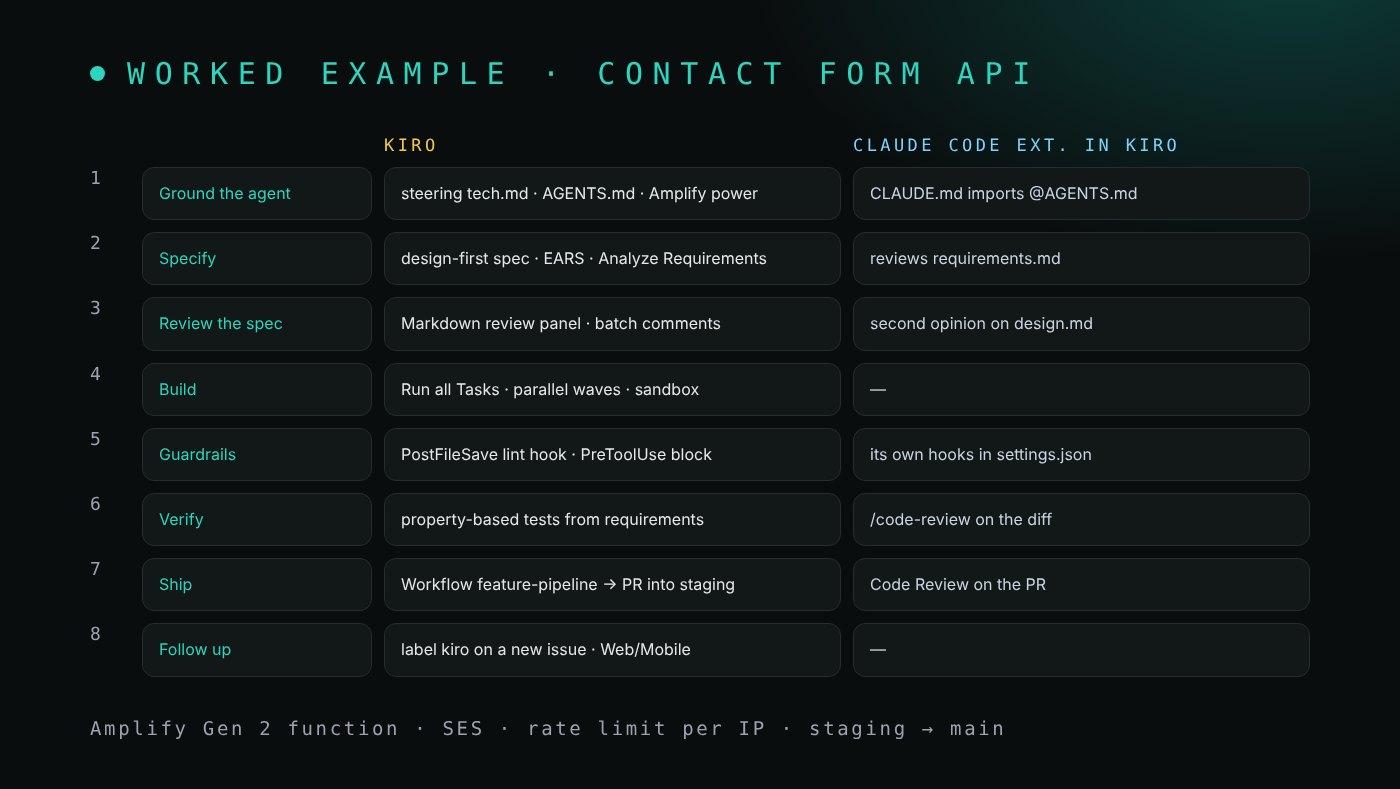
Here is how the pieces combine on a real feature for a site like this one, a Next.js app deployed on Amplify: a contact form whose API is an Amplify Gen 2 function that sends mail through Amazon SES and blocks repeated submissions from one IP.
- Ground the agent.
AGENTS.mdholds the branch model (feature branches intostaging,stagingintomain) and the test commands. ThefileMatchsteering file from above coversamplify/**. Install the Amplify power, so the agent only loads Amplify knowledge when the request needs it, and add the AWS MCP Server and skills from the Agent Toolkit. In the Claude Code extension, installaws-coretoo, so both agents look up SES and IAM the same way, andCLAUDE.mdimports@AGENTS.md, so both agents follow the same rules. - Specify. Start a design-first spec, since the data flow (form → function → SES, plus a counter per IP) is the decision that matters. The requirements are the three EARS criteria from the specs section. Run Analyze Requirements. It catches, for example, that "reject after 3 submissions" and "always respond 200 to the honeypot" need an order of evaluation.
- Review the spec. Open
design.mdin the Markdown review panel, comment on the passages you disagree with, and send them in one batch. For a second opinion, ask the Claude Code extension, which runs on a different model and plan: "Read.kiro/specs/contact-rate-limit/and list any requirement the design does not satisfy." - Build. Run all Tasks. The independent tasks (the function, the SES permission, the form component) run in parallel waves, with shell commands inside the sandbox and network limited to package registries.
- Guardrails. The
lint-on-savehook runs on every saved file. APreToolUsehook that exits 2 onnpx ampx sandbox deletekeeps the agent from deleting your sandbox stack. - Verify. Kiro generates property-based tests from the requirements: for any sequence of submissions from one IP, the fourth within ten minutes returns 429. Then run
/code-reviewfrom the Claude Code extension on the diff. - Ship. Run the
feature-pipelineWorkflow, thenpublish-prto open the pull request intostaging. Nothing merges on its own: an Amplify preview build verifies the change first. That is the same gate I describe in which Node builds your Amplify app and Stripe webhooks per Amplify branch. - Follow up. When a reviewer asks for a change, reply
/kiro fixin that review thread from your phone, and a cloud session pushes the fix.
The split is deliberate. Kiro owns the structured parts (specs, tasks, hooks, Workflows, AWS powers), and Claude Code is a second reviewer that reads the same files. If you work as a forward deployed engineer, this is also an easy way to fit into a client's AWS-first setup without giving up your own tools.
How this post stays up to date
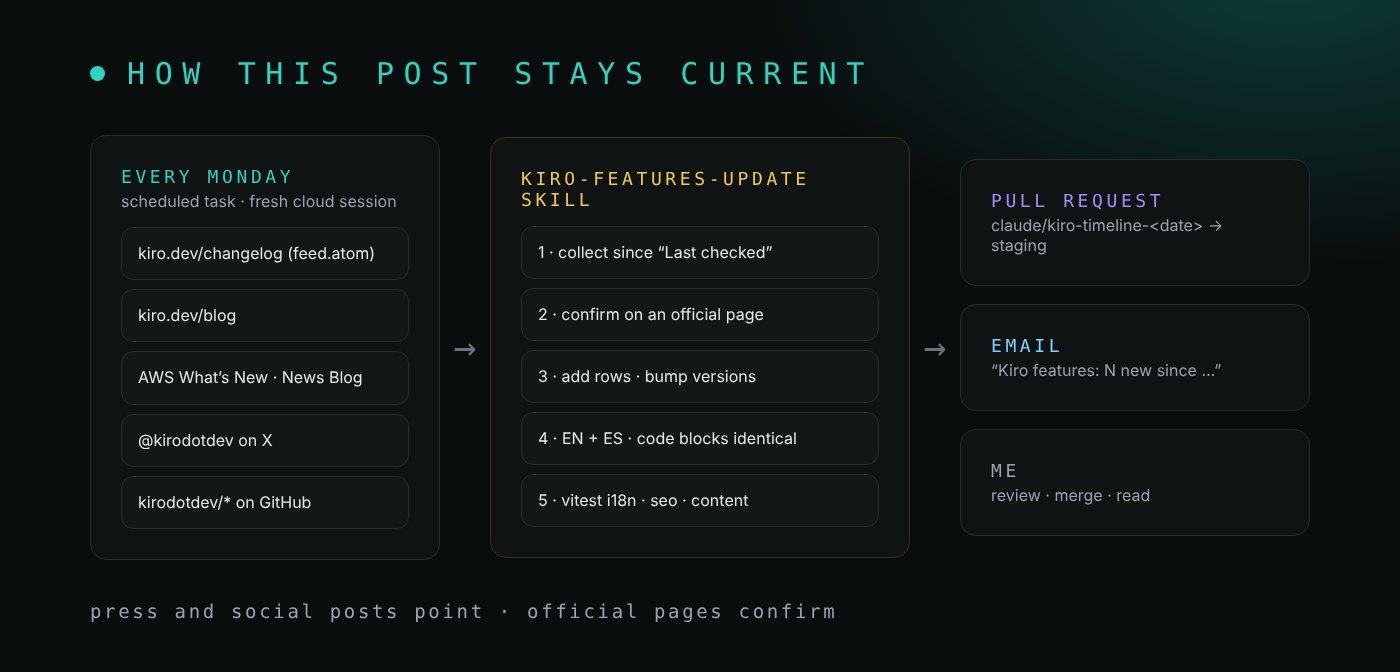
My Claude timeline uses the same setup, so I copied it:
- A scheduled task in Claude Code on the web runs every Monday morning in a fresh cloud session with this repository checked out.
- It follows a skill in the repository,
.claude/skills/kiro-features-update/SKILL.md. The skill reads the official sources: the Kiro changelog and its Atom feed, the Kiro blog, and Kiro entries on AWS What's New. Press, @kirodotdev and community write-ups only point it to things to confirm there. - It adds new rows to the timeline, updates the versions table, the Claude Code column and the "Last checked" date in both languages, runs the site's tests, and opens a pull request into
staging. - It emails me a summary: what is new, which products it touches, whether it works in Claude Code, and a link to the pull request. If nothing changed, the email says so in one line.
If you want the same thing without a repository, a Kiro Automation or a Claude Cowork scheduled task with the prompt "every Monday, list what Kiro shipped since last Monday from kiro.dev/changelog and email it to me" gets you 80% of the way.
Sources
- Kiro changelog: IDE, CLI, Web, Crew, models
- Kiro IDE 1.3.11: Markdown review and Kiro CLI 2.31: local command sandbox and local autonomous mode
- Kiro Web is now generally available and Kiro CLI 3.0
- Kiro is generally available and Introducing Kiro CLI
- Kiro docs: specs, steering, hooks, MCP, skills, powers, custom agents, workflows, sandbox, cloud sessions, enterprise, billing
- Kiro launches in AWS GovCloud (US) and FedRAMP High and DoD IL-4/5
- Agent Toolkit for AWS, aws/agent-toolkit-for-aws, Announcing Agent Toolkit for AWS and the user guide
- The AWS MCP Server is now generally available and awslabs/aidlc-workflows
- Claude Code in VS Code and its forks and Claude Code memory and imports