
Learning AI-DLC building a game, part 16: when auto mode said no
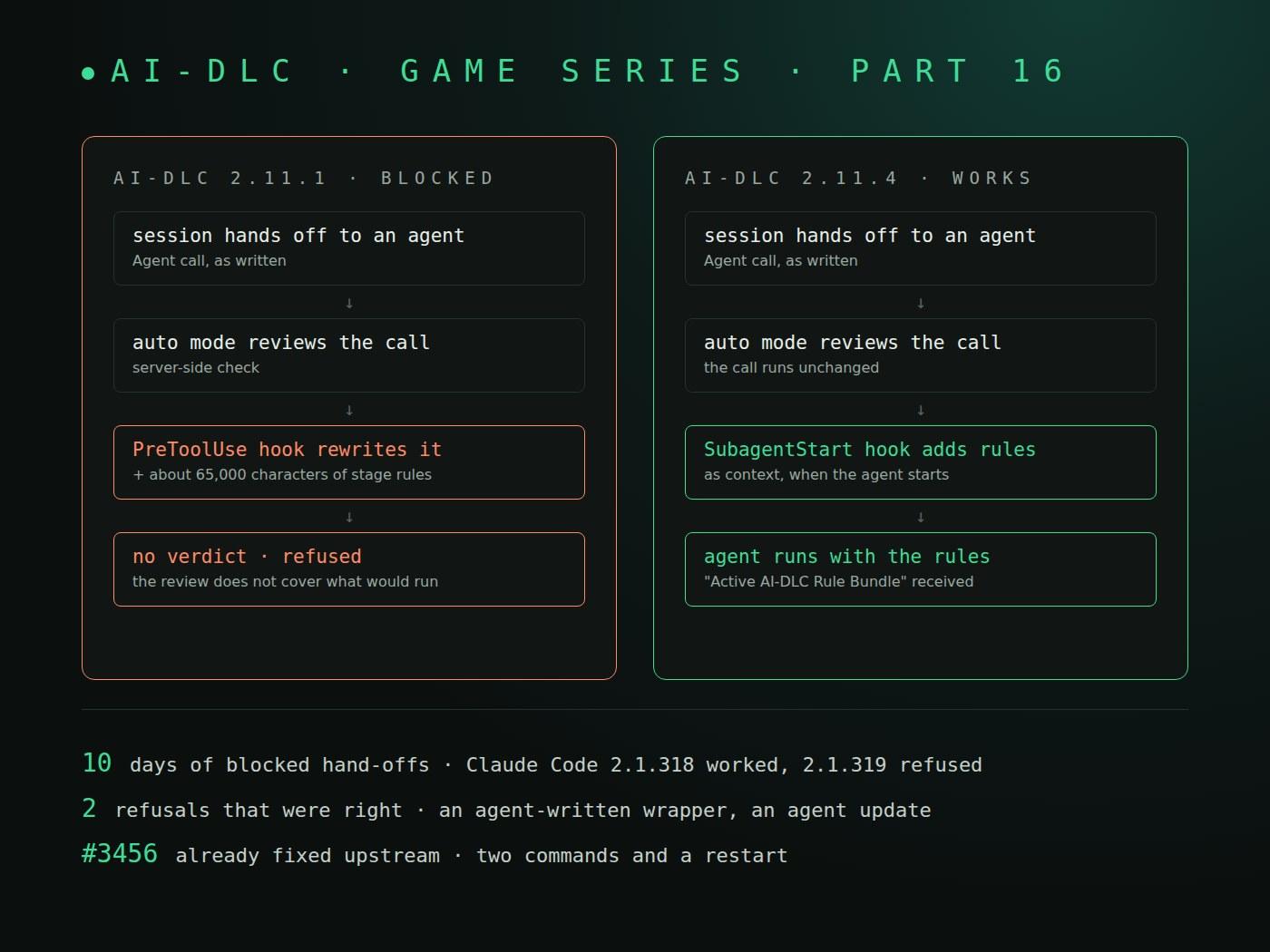
This is part 16 of a series on learning AI-DLC by building a game, World Rift Conflict, in Godot with an AWS backend. Part 1 set it up, and part 15 covered the agents. This one is about the ten days those agents could not be reached in Claude Code's auto mode, and the update that fixed it.
Parts so far:
- Part 1: setup
- Part 2: a proof of concept
- Part 3: automated E2E tests
- Part 4: what the reviews caught
- Part 5: inside a stage
- Part 6: a bugfix intent
- Part 7: ideation
- Part 8: inception
- Part 9: an AppSync deploy error
- Part 10: walking skeleton
- Part 11: retrospective
- Part 12: guards and hooks
- Part 13: a UI pass and a release
- Part 14: the memory layers
- Part 15: the agents and roles
- Part 16: when auto mode said no (this post)
The symptom
AI-DLC runs most stages inside my Claude Code session, and hands some work to separate agents: the developer that writes a unit's code, and the reviewers that check every stage. On 9 November every one of those hand-offs started to fail in auto mode with the same message:
The server-side auto mode classifier gave no verdict for Agent: a hook changed this call's input after auto mode reviewed it, so the review does not cover what would run.
Nothing else broke. Manual mode still worked, so the workflow went on, but every review meant switching modes first, and a session that restarted came back in auto mode and hit it again. My first question in the build log was the obvious one: "why is that a problem now, we have been working for days without that problem?"
Why it happened
Two rules, each reasonable on its own, met in the same call.
AI-DLC's side. Before every hand-off, AI-DLC runs a PreToolUse hook called deliver-stage-rules. It appends the stage's rule bundle to the agent's brief: the project's memory files and the stage's rules, about 65,000 characters in 39 sections for the stage I measured. The hook returns the longer brief as updatedInput, and Claude Code runs that instead of what was written. That is how an agent that never saw the conversation still works by the project's rules, the memory layers of part 14.
Claude Code's side. In auto mode, a server-side check reviews each call before it runs. A hook that rewrites the input afterwards means the check reviewed something else. Claude Code's error reference says it plainly: the denial "means a hook or mod changed the call's input after the server reviewed it, so the review doesn't cover what would run. It isn't a judgment that the action is unsafe." The hooks reference lists the few tools whose input a hook may still change in auto mode. Agent is not one of them.
What changed was Claude Code. My session logs show the last day hand-offs worked in auto mode on version 2.1.318, and the first refusal on 2.1.319. The AI-DLC hook had not changed since October. Neither had the model: the session ran Claude Opus 5.5 on both days, so switching models later did not cause it and could not fix it.
What did not work
- Project settings. No setting lets a hook change an Agent call in auto mode. Allowing the AI-DLC agents by name only helps outside it.
- A wrapper of my own. The hook's input says which permission mode the session is in, so the agent designed a wrapper that, in auto mode only, saved the rules to a file instead of rewriting the brief, plus a hook at agent start that pointed the agent to that file. AI-DLC's guard refused to let the agent write it: "A tool call cannot invoke a hook ... For intentional installed-file maintenance, use the official updater or an external terminal outside the running agent workflow."
- The agent updating AI-DLC. Claude Code's auto mode refused the agent's
aidlc updateas "Undermining Oversight".
Both refusals were right. An agent should not rewire the checks that watch it, however good its reason. The guards from part 12 did their job here too.
The fix was already out
When I asked the agent to open an issue in the AI-DLC repo, it searched first and found issue #3456, opened on 4 November, five days before my first refusal: "Claude Code auto mode cannot review a reviewer dispatch because a PreToolUse hook on Agent changes the call's input". It was closed the next day. The fix moved rule delivery to a SubagentStart hook, which adds the rules as context when the agent starts, so the Agent call runs exactly as auto mode reviewed it. It shipped in the stable AI-DLC 2.11.4 on 13 November.
My project was still on 2.11.1. I had tried to update to 2.11.3 on 9 November, and GitHub's release downloads answered 504 at the time. After that, nobody looked again. The update itself took two commands in my own terminal, then a full restart of VS Code:
aidlc update
aidlc config --harness claude
The second one reported create=58 update=243 merge=1 preserve=124 remove=0 conflict=0, kept my personal settings, and said "Your open work (default/261110-ai-rivals-signin) carries on."
The next review went through in auto mode on the first try. To be sure the rules still arrived, the brief asked the reviewer to say how it got them. Its answer: "I received the stage's rule bundle, injected at start in a block headed "Active AI-DLC Rule Bundle" (a SubagentStart hook)". The review itself came back READY with one major finding, a design that put the game's language in the wrong owner. So the rules arrived and the reviewer still did its job.
What I would tell myself
- When tooling that worked before breaks, check for an update and the issue tracker first.
aidlc update --checkand a search of the repo's issues would have found the fix in minutes. We designed a workaround before we looked. - Hooks that rewrite tool input and automatic permission checks do not mix. If you write hooks, add context at a step that does not change the call, as AI-DLC's
SubagentStartfix does. - Updating the framework is your step, not the agent's. Both AI-DLC and Claude Code refused to let the agent do it. Run the updater yourself, read its dry run, and restart fully, since hooks load at start.
- Do not blame the model for a tooling change. The model changed during these ten days, but the cause was a Claude Code release. The session logs, not memory, settled it.
What is next
Back to the game: the screen that shows the computer-run countries' reasons, built by the agents that can now be reached in auto mode again.