
Learning AI-DLC building a game, part 18: how scopes pick stages
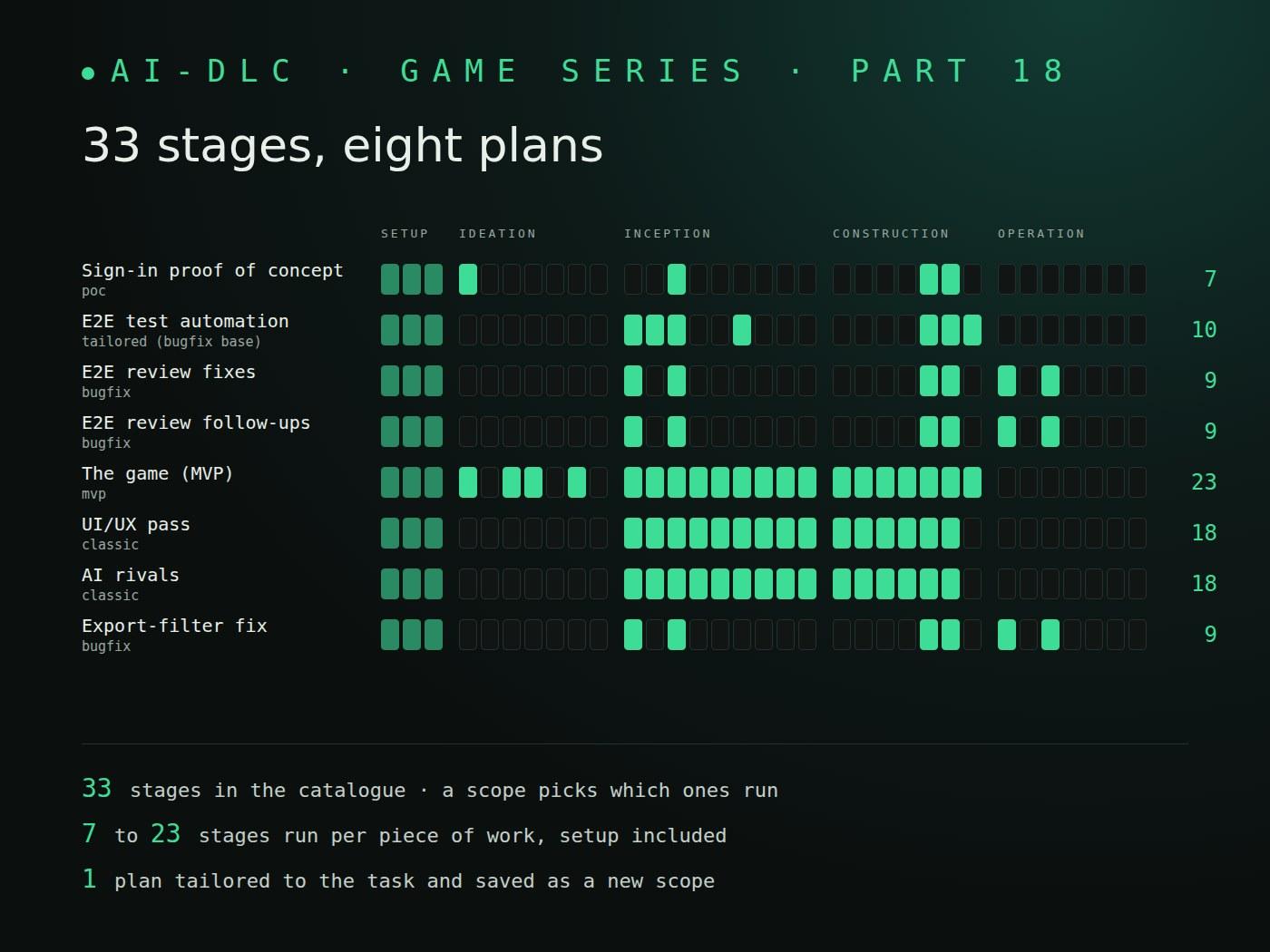
This is part 18 of a series on learning AI-DLC by building a game, World Rift Conflict, in Godot with an AWS backend. Part 17 was the biggest feature so far, and the one after it was a one-line fix to the export filters. Both went through AI-DLC, but not through the same stages. This post is about what decides that: the scope.
Parts so far:
- Part 1: setup
- Part 2: a proof of concept
- Part 3: automated E2E tests
- Part 4: what the reviews caught
- Part 5: inside a stage
- Part 6: a bugfix intent
- Part 7: ideation
- Part 8: inception
- Part 9: an AppSync deploy error
- Part 10: walking skeleton
- Part 11: retrospective
- Part 12: guards and hooks
- Part 13: a UI pass and a release
- Part 14: the memory layers
- Part 15: the agents and roles
- Part 16: when auto mode said no
- Part 17: AI rivals that explain
- Part 18: how scopes pick stages (this post)
The problem
AI-DLC's catalogue has 33 stages in five groups: three setup stages, seven for Ideation (intent, market research, feasibility, scope, team, rough mockups, hand-off), nine for Inception (from reverse engineering the code to delivery planning), seven for Construction (design, code, build and test, CI) and seven for Operation (deployment, monitoring, incident response and more). Each stage asks questions, writes documents, may call a reviewer, and stops for approval.
That is the right amount of process for a new product. It is far too much for a bug in an export filter. A scope is how AI-DLC decides which of the 33 run, and how heavily.
What a scope is
A scope is a small Markdown file in .claude/scopes/. This install ships eleven, and I added a twelfth. The header of the bugfix scope:
name: bugfix
depth: Minimal
keywords: [fix, bug, broken, bugfix]
description: Fix a specific bug
skeleton: off
review_cap: advisory
guard_policy: off
sensors: on
learnings: off
summary_confirmation: off
plan_approval: on
collaborators: off
The body lists which stages run and explains why: a bug fix needs to understand the code, say what "fixed" means, change and test it, and ship it. It does not need market research or user stories.
So a scope sets more than the stage list:
- Depth (Minimal, Standard or Comprehensive): how many questions a stage asks and how detailed its documents are.
- Reviews:
advisorycaps every stage review at the advisory class,noneturns reviewers off. With no cap, a stage uses its own review class, which can be the stricter adversarial one (part 4 shows both). - Walking skeleton: whether the first unit of Construction must be a thin end-to-end slice, approved before anything else (part 10).
- Guards (part 12), learnings (the "keep that for next time?" question that writes to the memory layers), summary confirmation, plan approval before code is written, and collaborators (support agents next to a stage's lead agent, part 15).
The extremes: enterprise and feature run all 33 stages. express runs requirements to deploy with no design pass and no reviewers. classic runs setup, all of Inception and Construction up to Build and Test: 18 of 33.
What this project actually ran
Eight pieces of work so far. The grid below was built by a script from each one's state file, aidlc-state.md, which lists the stages to execute and to skip.
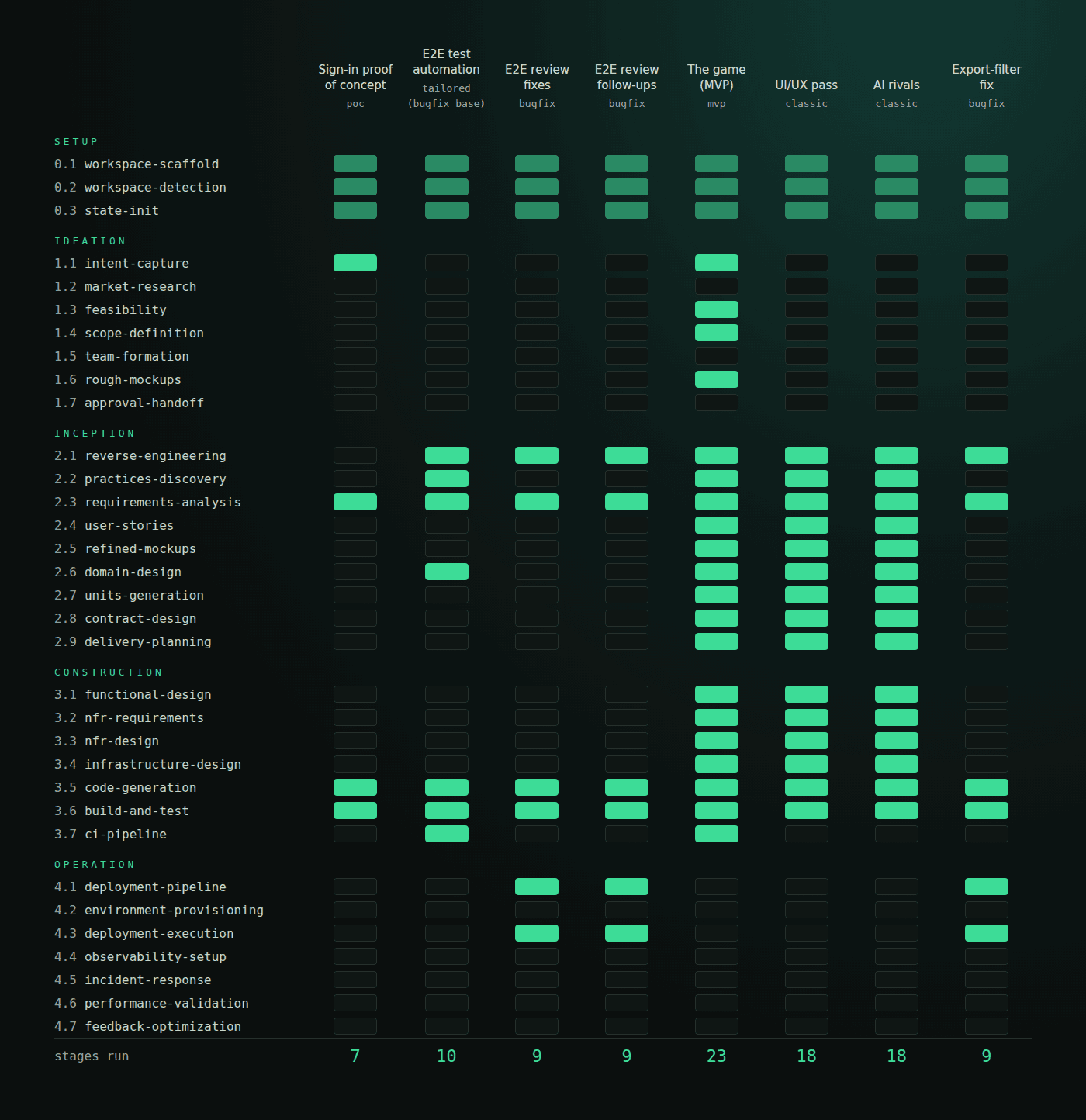
A few things the grid shows:
- No piece of work ran most of Operation. None of the scopes used here includes monitoring or incident response. The deploys ran as two stages in the bugfix scopes and, everywhere else, as the project's own practice: I push
mainand Amplify builds it. - Practices Discovery ran only in the larger scopes. It is the interview that writes the team's rules (branching, tests, deployment).
pocandbugfixskip it, so the first piece of work, a proof of concept, ran with AI-DLC's default practices until the E2E work added the stage. - Reverse Engineering was skipped in the proof of concept because there was no code yet. The state file says so: "2.1 (reverse-engineering — greenfield)". A scope lists stages, and AI-DLC still drops the ones that do not apply.
mvpran four of the seven Ideation stages (intent, feasibility, scope, rough mockups) and skipped market research, team formation and hand-off.
Two pieces of work side by side
Part 17's AI rivals and the export-filter fix were back to back, in the same codebase.
AI rivals, classic, 18 stages. Standard depth, every Inception stage, all four Construction design stages, and five units of work in Construction. A practices interview that settled what may be sent to an AI model. It ran from 10 to 27 November.
The export-filter fix, bugfix, 9 stages. Minimal depth: Reverse Engineering scanned only the nine files near the bug, Requirements Analysis asked three questions, then code, Build and Test, and the two deployment stages. One advisory review per stage, no learnings question, no summary to confirm. It ran from 28 to 29 November, and the public web pack lost the 42,980 bytes of test report it should never have had.
Same tool, same rules about tests and AWS actions, a very different weight. The scope did that, not me trimming steps by hand.
How a scope gets picked
There are three ways, and I have used all of them.
- Name it.
/aidlc poc Prove a Godot 4.7 game can sign a player in…started the proof of concept, and/aidlc mvp lets start with the game idea brainstorming…started the game. - Keywords. Most scopes list words that select them:
fix,bug,brokenforbugfix,proof of concept,prototype,spikeforpoc. They match whole words, so "debug" and "fixture" do not triggerbugfix. - Let AI-DLC propose one. For the UI pass and the AI rivals I only described the work. AI-DLC answered with a plan offer:
I'd run the "classic" plan for: … - 15 stages, 15 approval gates, 5 stages repeat per unit of work in Construction. Do you want me to go ahead with it, use a different plan, or tailor one to this task?
Both times I answered "Go ahead with the "classic" plan".
One detail about the numbers: the offer says 15 stages and the state file says 18. The offer leaves out the three setup stages, which need no approval. It is the same for the others: the proof of concept was offered as "4 stages, 4 approval gates" and recorded as 7, the export fix as "6 stages, 6 approval gates" and recorded as 9.
Compose: a plan made for the task
The third answer, "tailor one to this task", is called compose. I used it once, for the E2E test automation in part 3.
None of the shipped scopes fit. The work was small, like a bug fix, but it added a whole test kit with a design worth reviewing, and it set the test practices for the rest of the project. Before choosing I asked AI-DLC what each plan type meant, then picked "Tailor a plan". The tailored plan started from bugfix and changed it:
- added Practices Discovery (the interview that settled tests and branching), Domain Design (the design of the test kit) and CI Pipeline;
- dropped the two deployment stages;
- raised the depth to Standard and the reviews to adversarial.
Then "Approve and save as scope", with the name godot-e2e-automation. That wrote a new file next to the shipped ones:
name: godot-e2e-automation
depth: Standard
keywords: []
description: Plan saved from 261027-e2e-automation, based on bugfix
skeleton: off
review_cap: adversarial
learnings: on
summary_confirmation: off
plan_approval: on
It has no keywords, so it is only picked by name. I have not used it again yet: the work since then fitted bugfix, mvp or classic.
What I would tell myself
- Pick the scope by risk, not by size. The E2E kit was small but set practices for everything after it, so it needed a design stage and adversarial reviews that
bugfixdoes not have. - Read the stage list in the offer before saying yes. It is one line, and it tells you whether practices, design or deployment are in the plan.
- Know what the scope turns off.
bugfixhas no learnings question, so a correction made during a fix is not saved as a rule unless you turn learnings on. - A tailored plan is cheap to save. Saving it took one more answer, and it turns a one-off decision into a file you can read and reuse.
What is next
Measuring the cost of a real match with the model on, on the test backend, before switching the AI rivals on in production.